
Distek Thermal Diffusion Galvanizing in Utility Infrastructure: Lessons from Field-Proven Applications
Corrosion protection is not a theoretical exercise in utility infrastructure. For pole line hardware, fasteners, and structural components, coating performance directly affects service life, maintenance cycles, and operational risk.
One of the clearest real-world examples of how coating selection impacts long-term performance comes from Hubbell Power Systems, a long-standing supplier to electric utility and transmission markets. In a published technical overview, Hubbell details its use of Thermal Diffusion Galvanizing (TDG) with Distek Group’s ArmorGalv® TDZ process to extend the life of pole line hardware in corrosive environments
This article distills the engineering, testing, and performance insights from that material – and explains why TDG is increasingly specified as an alternative to hot-dip galvanizing (HDG) in critical infrastructure applications.
What Is Thermal Diffusion Galvanizing?
Thermal Diffusion Galvanizing (TDG), or Thermal Diffusion Zinc (TDZ), is a metallurgical vapor diffusion process that applies a uniform zinc-iron alloy coating to steel components.
Unlike hot-dip galvanizing, which relies on immersion in molten zinc, TDG uses a solid-state diffusion mechanism. Zinc atoms migrate into the steel surface at elevated temperature, forming a tightly bonded alloy layer rather than a discrete coating layer.
From an engineering standpoint, this distinction matters:
- Coating thickness is uniform across complex geometries
- Internal threads receive full corrosion protection
- The process avoids hydrogen embrittlement risks associated with acid pickling
Why Utilities Are Re-Evaluating HDG for Fasteners and Hardware
Hot-dip galvanizing has long been the default corrosion protection for utility hardware. However, Hubbell’s experience highlights several practical limitations when HDG is used in aggressive environments or on threaded components:
- Thread interference and galling, particularly after prolonged exposure
- Non-uniform coating thickness on edges, threads, and recesses
- Seizure of nuts and bolts during maintenance or replacement
These are not cosmetic issues. In utility infrastructure, seized fasteners can mean:
- Longer outage times
- Higher maintenance labor costs
- Increased safety risks during field operations
Salt Fog Testing: Distek’s ArmorGalv® vs. Hot-Dip Galvanizing
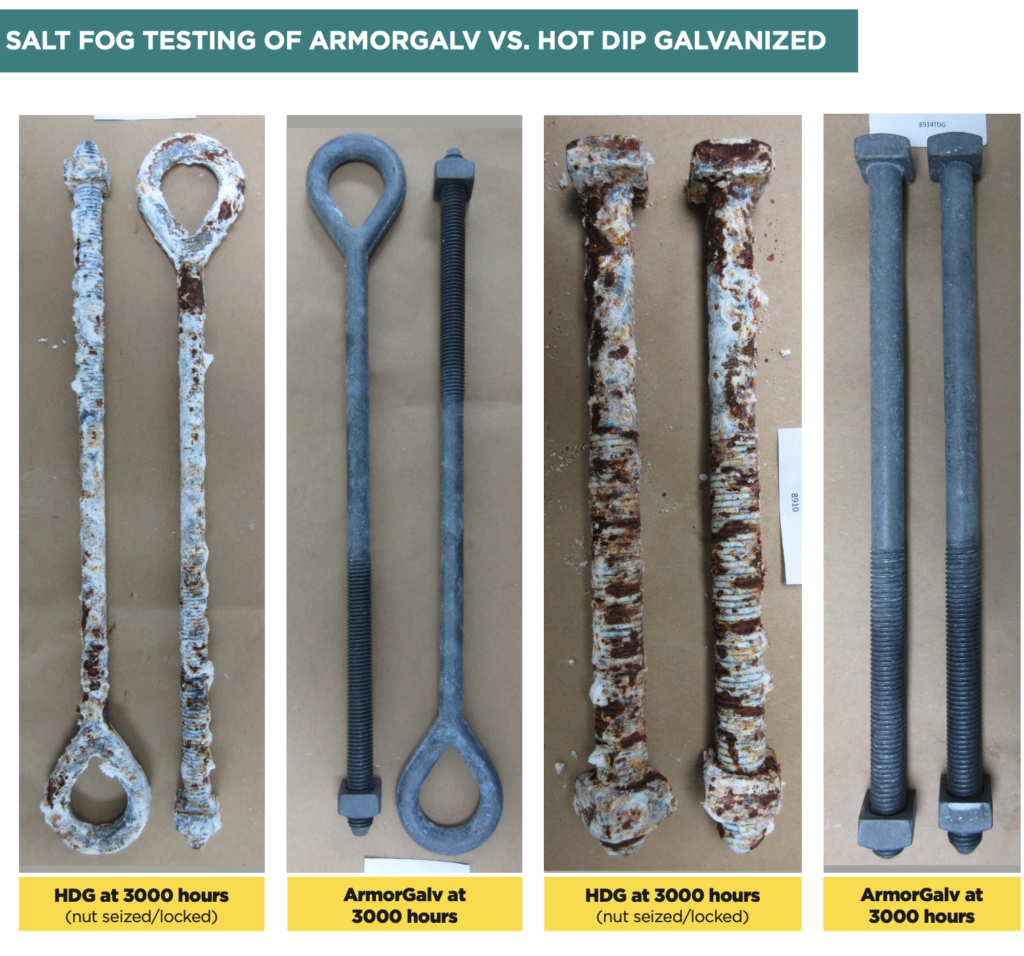
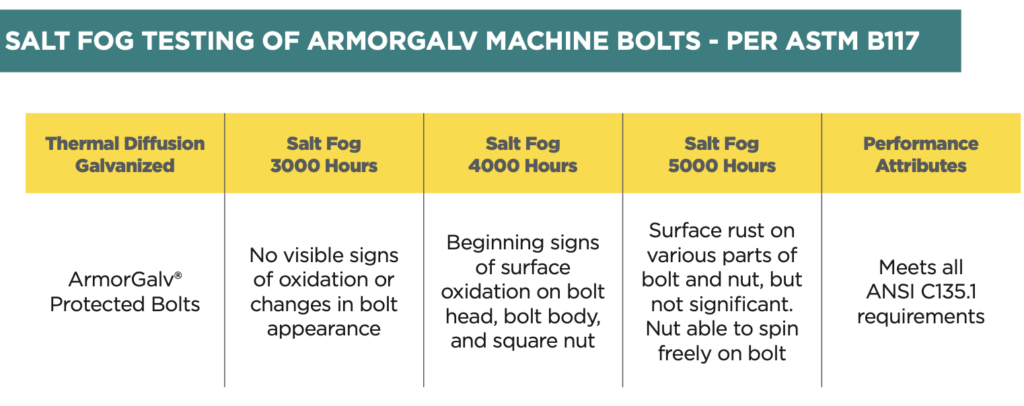
To evaluate long-term corrosion behavior, Hubbell conducted ASTM B117 salt fog testing on machine bolts protected with ArmorGalv® TDG and conventional HDG coatings.
Key Observations from Testing (ASTM B117)
- 3000 hours:
- ArmorGalv®: No visible oxidation; nuts remained free-spinning
- HDG: Nuts seized and locked
- 4000-5000 hours:
- ArmorGalv®: Gradual surface oxidation with maintained functionality
- Hardware continued to meet ANSI C135.1 requirements
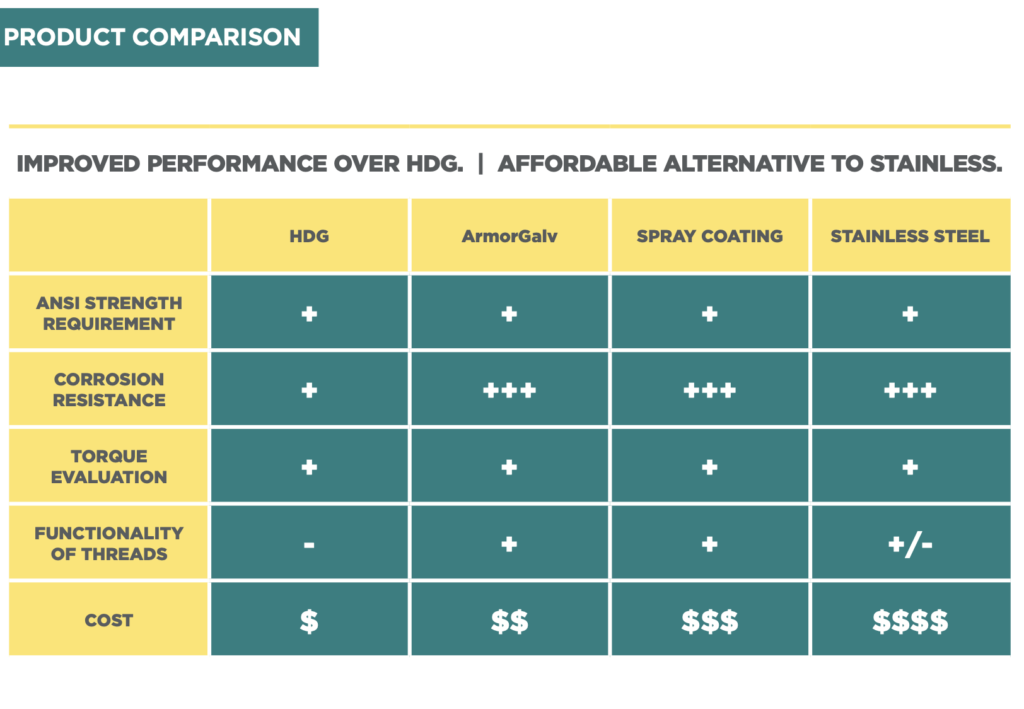
The practical takeaway is not just corrosion resistance, but functional durability – the ability to disassemble, inspect, and service hardware after years in corrosive exposure
Performance Characteristics From an Engineering Point of View
Based on Hubbell’s documented evaluation, ArmorGalv® TDG exhibits several properties that are especially relevant for infrastructure designers and maintenance engineers:
Corrosion & Mechanical Performance
- Improved corrosion resistance compared to HDG
- Negligible change to base material mechanical properties
- Anti-galling behavior in threaded assemblies
- Hydrogen-embrittlement-free process
Standards & Compliance
- Meets ASTM A1059 requirements
- Exceeds performance benchmarks of ASTM A123 and A153
- Compliant with RoHS, REACH, and Proposition 65
Sustainability & Process Considerations
- Acid-free surface preparation
- Non-toxic coating chemistry
- Virtually zero-waste system
- Viable replacement for cadmium and other hazardous anti-galling coatings
Application Scope: Pole Line Hardware and Beyond
Hubbell’s ArmorGalv® TDG portfolio includes:
- Machine bolts
- Oval-eye bolts
- Nuts
- Round, square, and curved washers
All components are produced in compliance with relevant ANSI, ASME, and NEMA specifications, demonstrating that TDG is not a niche or experimental solution – but a fully industrialized coating technology suitable for high-volume utility hardware manufacturing
Why This Matters for Infrastructure Owners and OEMs
From a lifecycle-cost perspective, the implication is clear:
- Longer service life
- Lower maintenance intervention
- Improved reliability of bolted connections over decades
For utilities and OEMs operating in coastal, industrial, or otherwise aggressive environments, coating choice becomes a strategic engineering decision – not a procurement afterthought.
Distek’s Role in Industrial-Scale TDG
Distek Group supplies the ArmorGalv® thermal diffusion galvanizing technology used by leading manufacturers to implement TDG with consistent process control, repeatability, and compliance.
The Hubbell case demonstrates how TDG performs when applied correctly, under controlled manufacturing conditions, and validated through recognized testing standards.
